
Direct Air Capture reimagined: Cleaning the atmosphere with a CO₂ conveyor belt
St. Gallen, 22.10.2026 — Removing CO₂ directly from the atmosphere has so far been a complex, energy-intensive, and expensive process. Empa researchers are therefore pursuing a completely new approach: Instead of trapping the greenhouse gas in bulky filter materials over long periods of time, extremely thin coatings are designed to absorb and release CO₂ in a matter of seconds – thereby requiring significantly less energy and material.
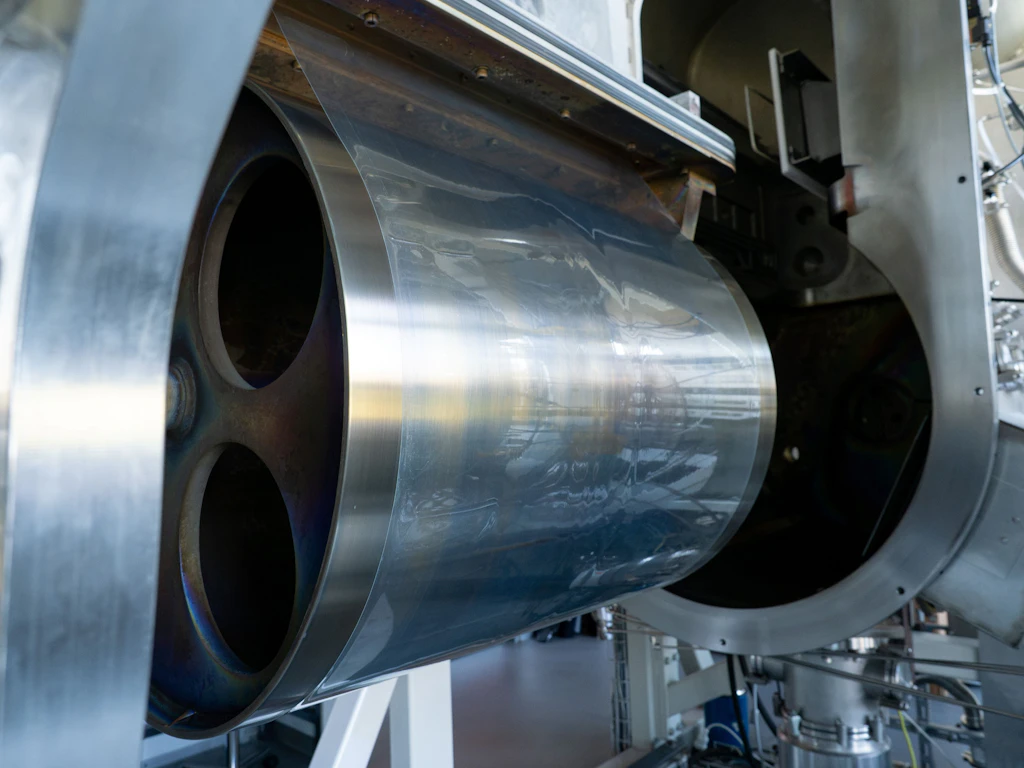
Filtering CO₂ directly from the air is considered a key step toward achieving net-zero emissions. So-called direct air capture technologies use fans to blow large volumes of air through porous filter materials. The carbon dioxide is trapped in the adsorber. It is then separated and – often in a vacuum and with the aid of steam – heated so that the CO₂ can be released and “captured.” This works, but it is complex, energy-intensive, and expensive: The concentration of CO₂ in the air is only about 430 ppm (parts per million) – a very low concentration for capture, but already significantly too high for the climate. As a consequence, enormous volumes of air must be moved to extract relevant amounts of the greenhouse gas.
Empa’s new approach is therefore deliberately designed differently from existing methods. It focuses not on maximizing storage capacity per cycle, but on speed. “We capture significantly less CO₂ per cycle and compensate for this with faster cycles,” says Empa researcher Sandra Galmarini. Instead of several minutes, a cycle is intended to take less than a second.
A thin coating instead of porous filters
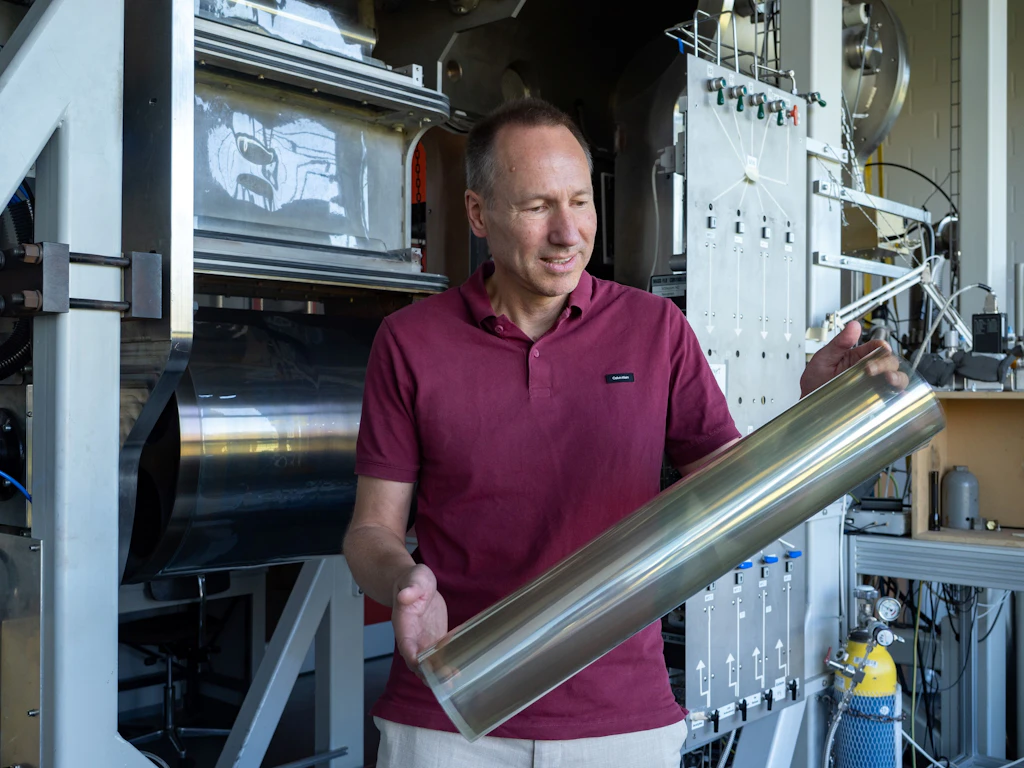
This is made possible by ultra-thin coatings made of amine-containing materials. Unlike conventional filter materials, they do not absorb CO₂ deep within their structure but instead bind it directly to the surface. “If you reduce the adsorption material to a surface or a very small volume, less CO₂ is bound per cycle, but the process can be significantly accelerated thanks to the low thermal mass,” says Empa researcher Dirk Hegemann. The advantage: When releasing the CO₂, significantly less material needs to be heated than with conventional adsorbents. This reduces the energy required per CO₂ molecule captured. At the same time, the rapid alternation between adsorption and desorption is only possible because the thin layers can be heated up and cooled down quickly.
According to the Empa researchers, the new approach can be illustrated by comparing it to a conveyor belt: A thinly coated surface moves – for example, over rotating cylinders – continuously through two separate zones. On one side, ambient air flows past and CO₂ adsorbs onto the surface. On the other side, the coating is heated and subjected to reduced pressure, allowing the CO₂ to be desorbed and the material to be recharged. The surface is then ready for the next cycle. A key advantage is that while adsorption and desorption are spatially separated, they are seamlessly linked by the moving material. To absorb CO₂, large volumes of air and sufficient space are needed so that air can flow past the material. For desorption, however, the smallest possible gas volume is advantageous because less energy is then required for the vacuum and for heating.
Modular system with huge potential
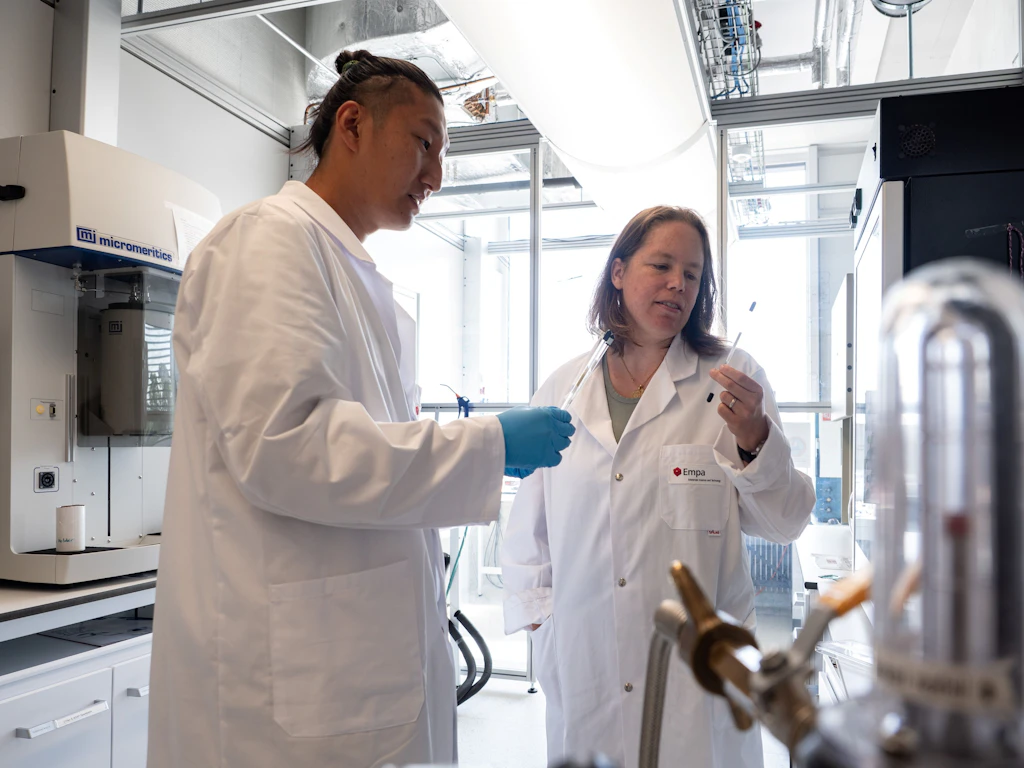
The idea emerged as part of the large-scale research initiative Mining the Atmosphere. There, Empa researchers from the teams led by Sandra Galmarini, Dirk Hegemann, Dorina Opris, and Manfred Heuberger investigated various ultrathin coatings and conducted initial flow and process simulations. The results showed that rapid CO₂ capture could, in principle, be possible and competitive. However, the experimental capabilities needed to actually measure the critical processes in fractions of a second are currently lacking. The initial focus is therefore on developing a novel measurement platform. Using this platform, the researchers aim to track, for the first time, how quickly CO₂ is bound to and released from ultrathin layers. “Using this data, we want to show whether we can achieve enough CO₂ per unit volume and time to keep pace with current technologies,” says Galmarini. While Dirk Hegemann is working on functionalizing the surfaces using plasma coating, a test facility is ultimately essential. Among other things, it will be used to investigate the stability of the thin films over many cycles, as well as seals and pressure zones at high rotational speeds.
In addition to speed, the Empa researchers see other advantages. Thinly coated surfaces require less material and are easier to replace than today’s highly specialized adsorbent materials. Furthermore, the rotational movement of the coated material itself could help transport air, thereby reducing the energy required for fans. According to Hegemann, the approach is also designed to be modular: “Instead of building such systems that are ever larger and more technically complex, many smaller units could be combined.” Galmarini adds: “Today’s technologies make sense primarily in large-scale systems. With our approach, we would also have the option of operating smaller – and thus more flexible – systems.” Although many questions remain, the researchers see great potential. Ultimately, the goal is not only CO₂ capture but a holistic process chain in the spirit of Mining the Atmosphere, to produce reusable materials and chemicals from captured carbon.
Further information
Dr. Sandra Galmarini
Building Energy Materials and Components
Phone +41 58 765 4066
sandra.galmarini@empa.ch
Dr. Dirk Hegemann
Advanced Fibers
Phone +41 58 765 7268
dirk.hegemann@empa.ch